
A foot carries your entire weight through roughly seven thousand steps a day, through twenty-six bones, thirty-three joints and a hundred-odd muscles, tendons and ligaments, inside a shoe that was chosen for how it looks. Then it gets ignored until it complains.
Dubai makes this worse in specific ways, and a foot massage addresses most of them. Here is the honest version of what it does and does not do.
What is actually happening in there
Three things go wrong with feet, and all three respond to hands.
The arch tightens. The plantar fascia running along the sole shortens under load, and standing all day or walking on hard mall flooring keeps it short. That is the tight, sore-first-thing-in-the-morning feeling, and slow thumb work along the sole is the direct answer to it.
Circulation slows. Feet sit at the far end of the plumbing, and heat plus long sitting plus long flights all conspire to leave fluid where it should not be. Sustained pressure moving toward the heart pushes it back, which is why ankles look different after the hour than before.
The calf takes over. Feet and calves work as one chain. A sole that cramps at night is frequently a calf problem wearing a disguise, which is why any competent foot session finishes with work above the ankle rather than stopping at it.
That is the whole mechanism: mechanical work on tissue, circulation, and range of motion in the joints. It is not reflexology, which is the separate practice of mapping zones of the foot to internal organs, and we make no claims of that kind.
Why Dubai feet in particular
The mall problem. Dubai Mall and Mall of the Emirates are measured in kilometres, and people walk them in shoes chosen for the evening, not the distance.
The standing shift. Retail, hospitality and front-of-house staff in this city work long ones, often on polished stone floors, which is the least forgiving surface there is.
The heat and the flights. Both encourage swelling, and residents here do more short-haul flying than most.
The heel hours. Anyone whose evenings involve heels has already made peace with the first hour afterwards; that hour is exactly what this treatment shortens.
What the session is like
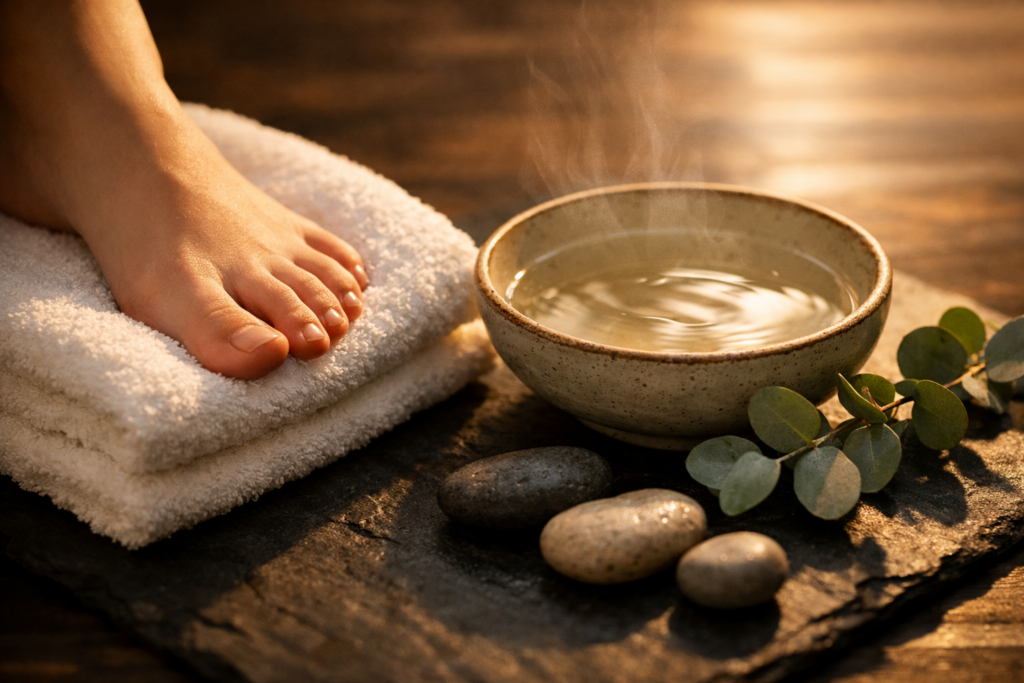
At U Spa it runs 60 minutes and costs AED 550. Feet are washed first, always. Then one foot at a time: broad warming strokes, thumb work through the arch, slower and heavier pressure on the heel, each toe moved through its range, the ankle rotated and stretched, and the last stretch of the hour spent on the calf.
Pressure runs firmer than in an oil massage because foot tissue tolerates it well, and it drops the moment you say so. Most guests are surprised by two things: how much the ankle work matters, and how quickly they stop noticing the room.
Details, booking and the current rate are on the foot massage page.
Who gets the most out of it
People on their feet all day, obviously. Runners, whose arches take the pounding that hips get blamed for. Frequent flyers with swollen ankles. Anyone whose sleep is interrupted by calf or foot cramps. And people who book massage regularly for their back and have never once had the part of them doing the most work touched.
It also pairs well with the rest of the menu. After a deep tissue session on the back, an hour on the feet the following week finishes the chain from the other end. After an aromatherapy hour it is simply the most relaxing sixty minutes available in the building.
Keeping the effect between visits
Roll a ball under the arch for two minutes per foot in the evening: a tennis ball works, a frozen water bottle works better if the arch is inflamed. Stretch the calf against a wall, thirty seconds each side, twice. Change shoes across the week rather than wearing one pair every day, because feet adapt to a single shape and then object to any other. And if your feet swell on flights, walk the aisle once an hour, which is duller advice than a massage and works.
When to see a doctor rather than a spa: pain that is sharp and localised rather than diffuse, swelling on one side only, numbness, or anything that has not shifted in weeks. Massage is for tired feet, not for diagnosis.
FAQ
What are the benefits of a foot massage?
Looser plantar tissue, better circulation in the lower leg, more movement in the toes and ankle, and less of the ache that standing or walking all day leaves behind. Those are mechanical effects, and they are the ones we claim.
Is a foot massage the same as reflexology?
No. Reflexology maps zones of the foot to internal organs; a foot massage treats the muscles, fascia and joints of the foot itself. We do the second and not the first.
How long should a foot massage be?
An hour, if it is a standalone session. That is enough to treat both feet and the calves properly instead of hurrying one of them.
How much does a foot massage cost in Dubai?
AED 550 for 60 minutes at U Spa, VAT included, in a private room. Two guests booking together each pay 20% less.
Does it help swollen feet after a flight?
Usually, and the calf work at the end does most of that. Persistent, painful or one-sided swelling is a doctor's question, not a spa's.
How often should I book one?
Monthly for anyone on their feet all day; more often during a heavy training block or a stretch of long shifts.
Can I have it at night?
Yes, we take sessions until 05:00, and this is the treatment most often booked at the end of a long evening.