
A sports massage works the specific muscle groups your training loads, at a depth ordinary relaxation massage never reaches. It speeds up recovery between sessions, keeps tissue elastic, and catches tightness before it graduates into injury. At U Spa in Al Barsha it costs AED 750 for 60 minutes, bookable any day from 10:00 to 05:00, which covers both the 06:00 gym crowd and the ones who lift at midnight.
What it does that a regular massage doesn't
The difference is intent. A relaxation massage treats the whole body evenly; a sports session interrogates it. The therapist asks what you train, finds the muscle groups that carry the load, and spends the hour there: quads and calves for runners, shoulders and lats for swimmers, everything at once for CrossFit, because that is what CrossFit does.
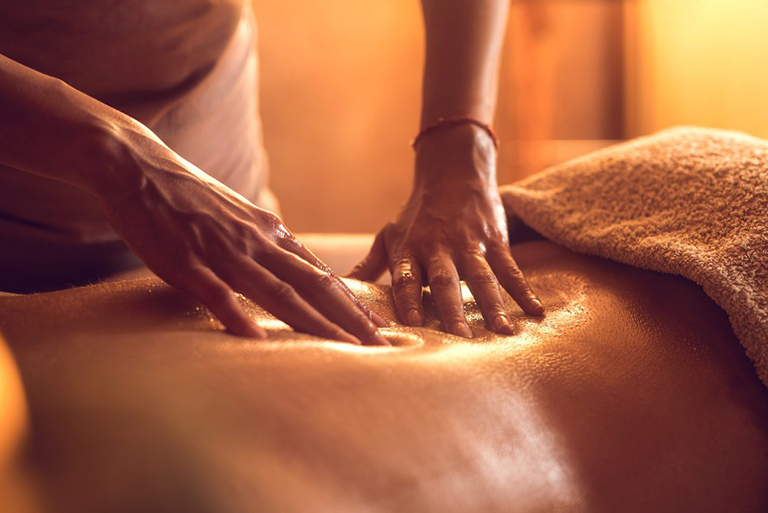
The techniques run deeper too. Targeted pressure, cross-fibre friction and stretching work into tissue that lighter styles only wave at, improving blood flow and oxygen delivery where the micro-damage from training actually sits. Booked within a day or two of a hard session, it noticeably shortens the stiff-legged aftermath; we broke down the timing in how massage supports recovery after exercise.
What a session looks like
It starts with two minutes of questions that matter: what you train, how often, what hurts, whether anything is currently injured, and whether there's a race or competition on the calendar. A therapist who skips that conversation is about to give you a generic massage with a sporty name.
Then the work narrows. On 60 minutes you get one or two muscle groups treated properly, which for most guests means legs or back and shoulders. Ninety minutes covers the full chain behind a sport, the hips and lower back that runners forget until they seize. Two hours is a full-body rebuild, usually booked at the end of a training block or after a marathon.
Pressure runs firm but conversational. Cross-fibre friction on a tight band is uncomfortable in a specific, useful way; anything sharp is a signal to ease off, and one word does it. Passive stretching goes in at the end, which is where most people notice the range of motion has come back.
Who books it here
Runners training for the Dubai Marathon and the winter race season, who arrive with calves like guitar strings. Gym regulars from the Al Quoz and Barsha Heights clubs, mostly in the day or two after a heavy leg session. Padel and tennis players, whose shoulders and forearms take the load in a way they only notice at 03:00. Cyclists off the Al Qudra loop with locked hip flexors. And a steady stream of people who don't consider themselves athletes at all but train four times a week, which makes them exactly the audience this treatment was designed for.
Prices
VAT included. The same rate whichever muscle groups the session covers.
| Duration | Price |
|---|---|
| 60 minutes | AED 750 |
| 90 minutes | AED 1,175 |
| 120 minutes | AED 1,500 |
Before 15:00 the Early Bird rate brings a 60-minute classic session to AED 400, which suits anyone whose training schedule leaves mornings free. Training partners who come together both pay 20% less. Regulars on training cycles book series and the per-session price drops on a course; ask on WhatsApp for the current arithmetic. Full menu on the price list.
Before training or after?
Both exist and they differ. Pre-event work is shorter, brisker and aims to wake the muscles up without wringing them out; book it the day before or the morning of, never deep and never for the first time. Post-training work is the deep, slower kind that most guests book, and it lands best within 48 hours of the hard session.
If your problem is not sport but a knot that has squatted between your shoulder blades since March, that is deep tissue massage territory; the styles are cousins, and the therapist will tell you honestly which one your back is asking for.
Where we are
U Spa sits on the R floor of the Donatello Hotel in Al Barsha, five minutes from Mall of the Emirates, next to the Sharaf DG metro station, with free parking at the hotel. Gym-goers reach us quickly from Al Quoz, Barsha Heights and TECOM, JLT and the Marina; the full list of districts is on the massage near me page. Late closing at 05:00 is the part athletes use most, since it fits the session after the evening training block rather than instead of it.
Book on WhatsApp at +971 56 735 5473.
FAQ
How much does a sports massage cost in Dubai?
AED 750 for 60 minutes at U Spa, AED 1,175 for 90, AED 1,500 for 120, VAT included. Before 15:00 the Early Bird rate is AED 400.
When should I book it: before or after training?
After, for most people, ideally within 48 hours of a hard session. Pre-event massage is a different, shorter format; say which one you need when booking.
Does sports massage hurt?
It works deep and you will feel it, but pain is not the goal and the pressure adjusts to you. Soreness the next day, similar to a light workout, is normal.
How often should I book one during a training block?
Every two to three weeks suits most amateur schedules, weekly in a heavy block or before a race. More useful than one heroic session a year, and cheaper per month than most people expect.
I don't do sport, just have tight shoulders. Right massage?
Probably deep tissue rather than sports massage. Same depth, different focus; the therapist can switch approach on the table if needed.
Can I book late, after evening training?
Yes. The last sessions start well after midnight and we close at 05:00, so a 22:00 gym finish still leaves room for a full 90 minutes.
Can athletes book recovery courses?
Yes, series bookings come out cheaper per session. Message +971 56 735 5473 with your training schedule and we'll suggest a rhythm.