

Adding a second or third therapist does not change the technique of a massage. It changes how the hour is divided. One therapist works one area at a time, two work in mirror image on both sides of the body, and three cover the body, the feet and the head at once. This guide compares the three formats so you can tell which one fits what you want from the session.
One therapist: depth and focus
A single therapist can stay in one place. If the problem is a knot under the shoulder blade or a tight lower back, they can spend twenty minutes there, change the angle, wait for the muscle to let go and come back to it later. That patience is the strength of the format, and it is why slow, specific work such as deep tissue is done by one person.
The trade-off is sequence. While the hands are on the left shoulder, the right one waits. Part of your attention follows along: left side now, right side next, lower back after that. The tracking is quiet, but it keeps the mind slightly on duty.
Four hands: symmetry and coverage
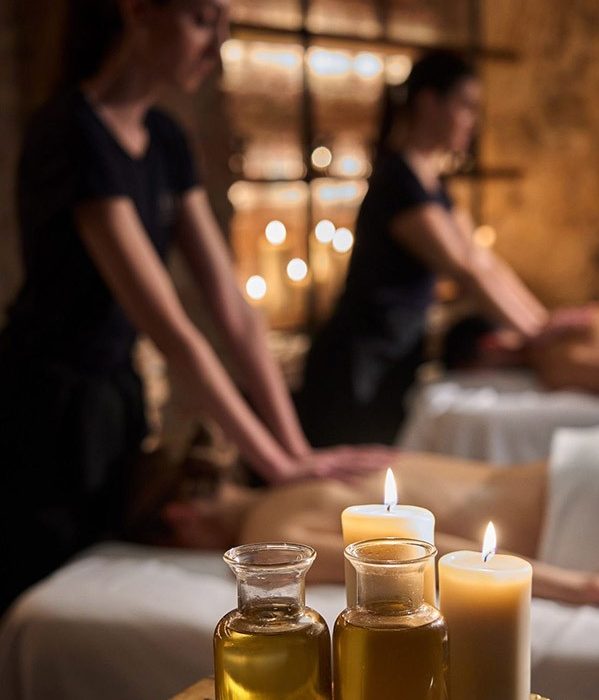
Two therapists stand on either side of the table. One leads, setting the rhythm and the pressure, and the other mirrors: when the left shoulder is being worked, so is the right; when one pair of hands moves down the back, the other moves with it. Later in the session they split the body, one on the back and one on the legs, or one on the feet and one on the scalp, so two areas are treated at once.
The strokes are classical: oil, long gliding movements, kneading across the shoulders, steady pressure along the spine. You say one thing about pressure, once, and it applies to both, because the lead therapist adjusts and the second follows.
Two things change for the guest. The first is that there is too much happening to follow, and most people describe the same moment, a few minutes in, when they stop trying. The second is coverage: sixty minutes of four hands gives the body something close to two hours of attention, which is the exception to the usual arithmetic in how long a massage should be.
Six hands: the same idea with a third therapist
Six hands adds a third therapist, usually working the feet and head while the other two cover the body. Nothing waits its turn at all. It is the most intense version of the format and is booked mostly for celebrations. It suits guests who have tried four hands and already know they like the feeling.
Side by side
| One therapist | Four hands | Six hands | |
|---|---|---|---|
| Therapists | 1 | 2 | 3 |
| How the work is divided | One area at a time | Mirrored strokes, then two areas at once | Two on the body, one on feet and head |
| What it does best | Slow work on one problem area | Whole body in one hour, a quiet mind | The fullest version of the same effect |
| Pressure instructions | Adjusted area by area | Given once, both follow | Given once, all three follow |
| Good first choice for | Tension in one specific place | Guests who cannot switch off | Guests who already like four hands |
How to choose
Choose one therapist if a specific area needs serious work. Two therapists moving in symmetry cannot spend twenty minutes on a single knot.
Choose four hands if you want the whole body covered in an hour, or if you have tried quieter sessions and still spent the hour thinking. It also suits the evening after a long flight, when the aim is to reset everything at once.
Choose six hands for an occasion, once you know the format suits you.
And if the point is to be with someone, none of the three is the answer: a couples massage gives each of you your own therapist in the same room, while four and six hands are for one guest.
What first-timers worry about
Draping is the same as in any other massage, and only the area being worked is uncovered. The session is less awkward than people expect, because neither therapist is watching you; they are watching each other to stay in sync. If you would like the room quiet, say so before the session starts. If you are building a longer afternoon around it, the spa day planning guide covers the order of bath, sauna and massage.
Session lengths, prices and booking for the four hands massage in Dubai at U Spa are on the service page.
FAQ
Is a four hands massage awkward?
Less than people expect. The therapists are focused on staying synchronised with each other, draping is the same as in any session, and after the first few minutes most guests stop noticing there are two of them.
Do both therapists do the same thing?
For the first part, yes, in mirror image. Later they split the body, so one works the back while the other does the legs or the feet. You give pressure instructions once and both follow.
Is four hands better than a longer session with one therapist?
It depends on the goal. For the whole body in an hour, four hands gets through roughly what one therapist does in two. For one problem area worked slowly and deeply, a longer session with one therapist is the better choice.
Can a couple book four hands?
Four hands is one guest with two therapists. A couple wants the couples room, where each of you has a therapist of your own, at the same time, in the same room.
Is six hands simply better than four?
It is more intense, not better. Four hands is the version to start with. Six hands suits guests who already know they like the format and want the fullest version of it.