
Heat does one thing that hands cannot do quickly: it relaxes a muscle before anyone has pressed on it. That is the whole idea behind a hot stone massage, and it is why the session suits a specific kind of guest, the one whose back is tight but flinches at firm pressure. If that is you, read on. If you want a knot dug out, you probably want deep tissue instead, and we explain why below.
What actually happens on the table
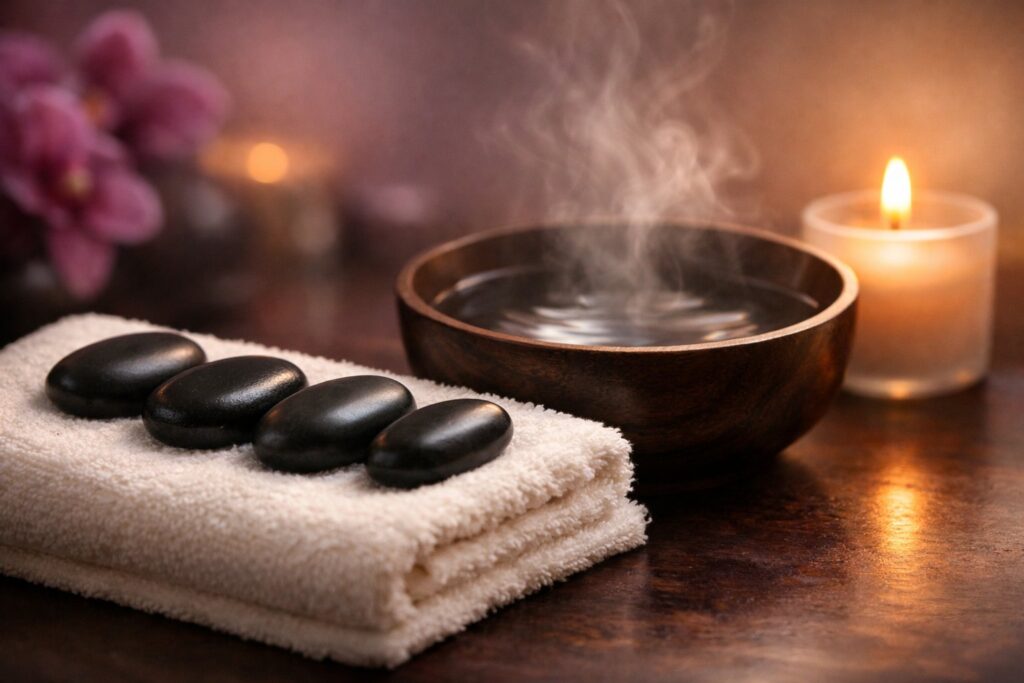
The stones are smooth, dark basalt, chosen because the material holds heat evenly and does not have edges. Before the session they sit in a warm water bath, and the therapist checks each one against their own skin before it touches yours.
The hour then runs in two modes that alternate. In the first, stones are placed and left: along either side of the spine, across the shoulders, sometimes in the palms or on the calves. They rest there while the therapist works elsewhere, and the warmth soaks in. In the second, the therapist holds a stone in each hand and uses it as an extension of the palm, gliding it along the muscle with oil, so the stroke arrives already warm. As a stone cools it goes back into the bath and a fresh one replaces it.
Nothing is hot enough to mark the skin. If a stone ever feels too warm, say so and it is lifted immediately; there is no toughing it out in this session, the heat is supposed to feel like a bath, not a test.
What the heat changes
Warmth brings blood to the area and lets the muscle let go of its guard. A back that would brace against a thumb accepts a warm stone without resistance, and once the tissue has softened the therapist can reach a depth that would otherwise have needed real force. The result is a massage that feels medium in pressure and lands like a firm one.
The second effect is on the head rather than the back. Lying under a line of warm stones is one of the few things that reliably stops people thinking, which is why this session is so often booked by guests who sleep badly. We wrote more about that angle in massage for stress and sleep.
Hot stone against a regular massage
A Swedish massage covers the body in a sequence at medium pressure; it is the reference point most people have. Hot stone follows a similar sequence, but with heat doing part of the work, so the same hour feels deeper and slower.
Deep tissue is the opposite approach: force applied precisely to two or three areas, no heat. If you can put one finger on the spot that hurts, deep tissue reaches it faster. If the whole back is a board and you cannot say where it starts, heat is the better tool, and this is the choice we see guests get wrong most often. Our page on massage for back pain walks through that decision.
Aromatherapy is the lighter cousin: oil and scent rather than heat, gentler pressure, and the usual pick for a first visit. Hot stone is for the guest who wants that calm but with more happening in the muscle.
Who it suits, and who should skip it
It suits people who spend the day cold under an air conditioner, which in Dubai is almost everyone with an office. It suits backs that are stiff rather than injured. It suits anyone who found their last massage either too hard or too light and could not explain which. And it suits the end of the day: an evening hot stone session is one of the best things on our menu for falling asleep afterwards.
Skip it, or ask first, if you have a fever, sunburn or a skin condition on the back, a recent injury that is still swollen, or any condition where heat is a bad idea for you. Tell us if you are pregnant; we will say plainly what is suitable. None of this is us being dramatic: heat on inflamed tissue makes it worse, and an honest no is cheaper than a wasted hour.
Getting the most out of the hour
Book 90 minutes if you want the legs and arms done properly as well as the back; at 60 minutes the back and shoulders get most of the attention. Drink water before and after, because warmth makes you sweat more than you notice. Say "too hot" or "firmer" the moment you think it, not at the end. And if you can come before 15:00, the Early Bird rate makes a classic session cheaper, which leaves room to add the stones.
Prices
VAT included, private room with its own shower.
| Treatment | 60 min | 90 min | 120 min |
|---|---|---|---|
| Hot stone massage | AED 700 | AED 1,050 | AED 1,400 |
| Swedish massage | AED 600 | AED 1,025 | AED 1,200 |
| Aromatherapy massage | AED 550 | AED 800 | AED 1,100 |
| Deep tissue massage | AED 750 | AED 1,175 | AED 1,500 |
The full menu is on the price list.
U Spa, R floor of the Donatello Hotel, Al Barsha, daily from 10:00 to 05:00. Booking by WhatsApp: +971 56 735 5473.
FAQ
Does a hot stone massage hurt?
No. The pressure is medium and the heat does the deep work. A warm, heavy feeling along the spine is normal; anything sharp or any stone that feels too hot is a signal to speak up, and it is fixed in a second.
Can the stones burn the skin?
Not when they are handled properly. Each stone is checked by the therapist before it touches you, and stones that have been in the bath too long are cooled first. Say so if one feels more than pleasantly warm.
Is hot stone better than deep tissue for a bad back?
It depends on the back. If the pain is in one spot you can point to, deep tissue reaches it faster. If the whole back is stiff and tenses under pressure, heat gets further than force.
How long should a hot stone session be?
Sixty minutes covers the back, shoulders and neck well. Ninety lets the therapist do the legs and arms with the same care, and is the length most guests rebook.
Is it a strange choice in summer?
No. The room is cool, the stones are the warm part, and most of our summer guests arrive from air-conditioned offices with exactly the cold-stiff shoulders this session is built for.