
Skin replaces itself from underneath, and the old layer does not always leave on schedule. It stays on the surface as a dull, slightly rough film that makes a tan look patchy, makes moisturiser sit on top instead of going in, and gives the elbows, knees and back the texture people notice in a mirror and cannot name. A body scrub removes that film. This page explains what is actually being taken off, how the Moroccan version does it with soap and a glove rather than a grainy cream, and how to get the most out of it.
What a scrub removes
Three things come off in a proper exfoliation: the dead cells that have finished their job on the surface, the residue of every product that has been applied over them, and the mix of sweat salts and dust that a shower rinses but does not lift. None of it is dirt in the ordinary sense, which is why people who wash twice a day still have it. It needs friction, and it needs the skin softened first so the friction does not hurt.
A loofah in the shower does a version of this, badly: the skin is not prepared, the pressure is uneven, and nobody can reach their own back. That is the difference between scrubbing at home and a Moroccan bath, where the preparation is half the point.
The three tools of the hammam
Steam. The ritual starts with around ten minutes in a warm, saturated room. The surface softens and swells slightly, and whatever is going to come off loosens its grip. Skip this step and the scrub has to be harder to achieve less, which is exactly what happens with a home scrub.
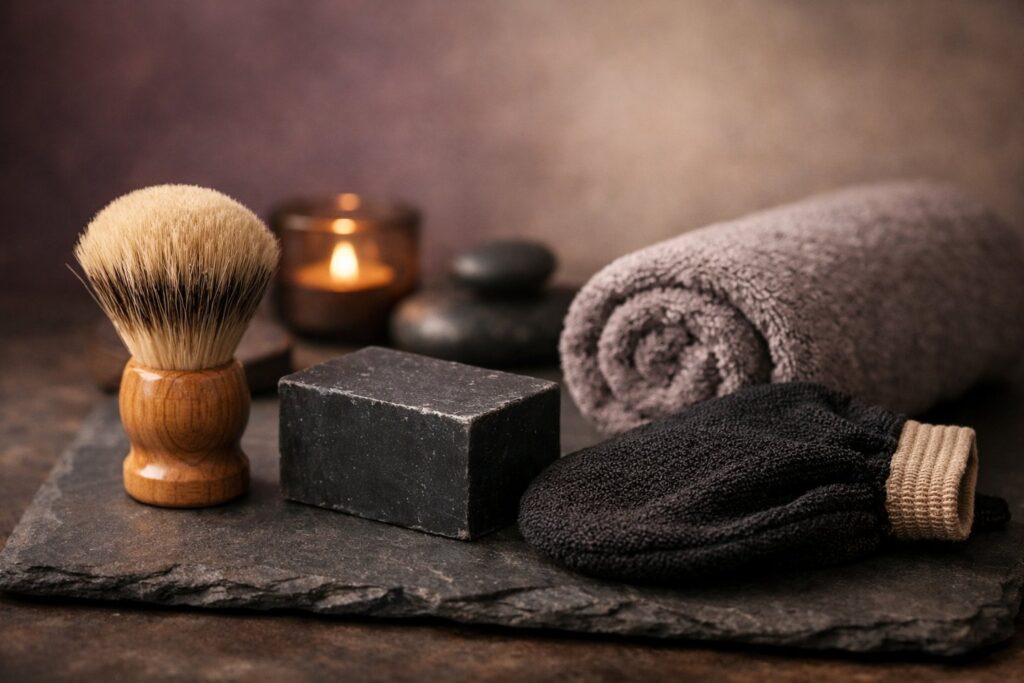
Beldi soap. A soft, dark, olive-based soap, closer to a paste than a bar. It is spread over the whole body and left for several minutes rather than rinsed straight off. The job is not to clean in the usual sense; it is to soften the loosened layer further so the glove can lift it.
The kessa. A coarse mitt, used in long firm strokes along the limbs and across the back. This is the part guests remember, because the result is visible on the skin as the therapist works: grey rolls of what the steam and soap have loosened come away in lines. It looks alarming the first time and is entirely normal. After the rinse the skin has a different texture, not just a cleaner one.
Some hammams finish with a clay mask or an oil; the sequence above is the core. The Royal version runs a full hour instead of 45 minutes and extends the ritual; the standard version is already the complete treatment.
What you notice afterwards
The first thing is the texture, the same day. The second is that products behave differently for a week or two: moisturiser absorbs, a tan comes up evenly, and the shoulders and back feel like the rest of the body rather than a separate, rougher surface. The third is slower and shows after a few monthly visits, when the skin on the back of the arms and the backs of the thighs stops being bumpy, because what was blocking it is being removed before it builds up.
What a scrub does not do is anything medical. It helps keep the skin clear; it does not treat a condition, and if you have one, the person to ask is a dermatologist, who will usually tell you whether a hammam is fine for you.
How often
Every three to four weeks is the rhythm that works for most guests. Weekly is too often: the new surface needs time to form before it is taken off again, and over-scrubbed skin gets tight and reactive. Less than every two months and you are starting from scratch each time. We went into the timing in more detail, including the before-and-after rules, in how often to have a Moroccan bath.
Before and after
Do not shave or wax on the day; the glove on freshly shaved skin stings, and the scrub lifts hairs more cleanly the day after anyway. Arrive with no body lotion on. Afterwards, stay out of direct sun for the rest of the day, moisturise that evening, and leave the loofah alone for a week; the surface is new and does not need more friction. If you are planning laser or a tan, the bath goes a couple of days before, never the same day, and never after.
Scrub or skin treatment
A scrub takes off. The chocolate and strawberry sessions put on: a warm preparation worked into the skin for the feel and the smell as much as the result. The useful order, if you want both, is the bath first and the treatment afterwards, on a surface that can actually absorb it. For a plain sweat without the scrub, the sauna is a different thing again; we compared the three kinds of heat in sauna, steam room and hammam.
Prices
VAT included, private hammam and shower.
| Session | Duration | Price |
|---|---|---|
| Moroccan bath | 45 min | AED 550 |
| Royal Moroccan bath | 60 min | AED 700 |
| Standard body treatment: bath + 60 min massage | about 105 min | AED 1,200 |
| Royal body treatment: Royal bath + 60 min massage | about 120 min | AED 1,400 |
The full menu is on the price list, and the step-by-step description of the ritual is in what a Moroccan bath is.
U Spa, R floor of the Donatello Hotel, Al Barsha, daily from 10:00 to 05:00. Booking by WhatsApp: +971 56 735 5473.
FAQ
Does the kessa glove hurt?
It is firm, not painful, on skin that has been steamed and soaped first. If it ever feels sharp, say so; the therapist eases the pressure, and it is usually a sign the steam was cut short.
How often should I get a body scrub?
Every three to four weeks. More often than that removes skin that has not finished forming; much less often and the film is back to where it started.
Can I shave before a Moroccan bath?
Better not on the same day. The glove on freshly shaved skin stings, and the scrub lifts hairs more cleanly if you shave the day after instead.
Will exfoliation help with ingrown hairs?
It helps keep the skin clear enough for hairs to come through, which is most of the problem. It is not a treatment for a skin condition; if the area is inflamed, see a dermatologist first.
Is it suitable for sensitive skin?
Usually, with lighter glove pressure; say so when you book. Skip it with sunburn, active eczema or broken skin, and come back when the surface has settled.