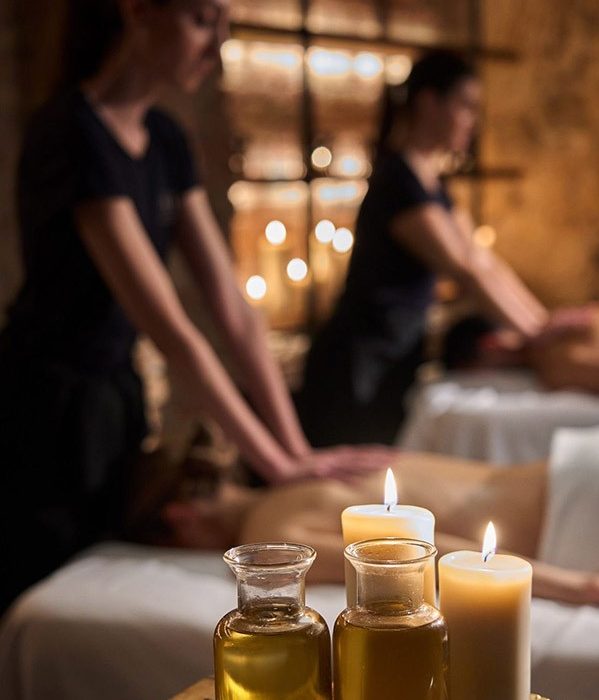


Lomi Lomi is the Hawaiian massage tradition, and the thing that makes it different is visible from across the room: the therapist works mostly with the forearms, in long strokes that run from the shoulder to the hip and down the leg in one movement, instead of stopping at each muscle in turn. Guests describe it as being moved rather than pressed. This page explains what the session involves, how it feels compared with the massages most people already know, and who gets the most out of it.
Where it comes from
The name comes from the Hawaiian word for kneading or rubbing, and the technique grew out of a tradition where massage was part of ordinary family and community life rather than a spa treatment. It reached the wider world in the last century and is now on the menu of most serious spas, including ours. What survived the trip is the method: continuous, rhythmic, whole-body work with the forearm as the main tool.
What the therapist actually does
Oil is applied generously, more than in a Swedish session, because the strokes are long and need to glide. The therapist then uses the flat of the forearm, the palm and sometimes the elbow in sweeping movements that cover large areas at once: the whole back in a single pass, the back of one leg from heel to hip, a stroke that starts at the neck and ends at the opposite foot.
The rhythm is steady and does not stop. Where a classical massage has a sequence of separate techniques, kneading, then pressure, then tapping, Lomi Lomi is closer to one long movement with varying weight. The therapist often works two areas in the same stroke, and may gently rock the body as part of it. The pressure is medium and spread over a wide surface, so it feels substantial without ever feeling pointed.
How it feels
Most guests use the same word, which is wave. Because the strokes are long and overlapping, the body cannot predict where the next one lands, and the usual low-level tracking that keeps the mind busy during a massage stops. The effect is close to what a four hands session achieves, but with one therapist and at a slower pace.
It is not a session for a specific knot. The forearm covers too much ground to dig into one spot, and that is by design. If what you need is twenty minutes of slow pressure on one shoulder, deep tissue does that; Lomi Lomi does the opposite, it treats the body as one connected piece.
Lomi Lomi or Swedish
Swedish is the reference most people have: medium pressure, a set sequence, hands rather than forearms, each area worked and finished before the next. Lomi Lomi uses the same classical foundation but replaces the sequence with flow. If you like knowing what comes next and want each muscle group handled in turn, Swedish. If you want to lose track of time, Lomi Lomi. We put the two side by side in Swedish vs Lomi Lomi.
Who it suits
Guests whose problem is the whole body rather than one part of it: the tiredness after a long week, the stiffness after a flight, the state of being wound up without any single sore spot. Guests who find firm, pointed pressure unpleasant but find aromatherapy too light. And guests who book massage for sleep; we explained why the slow, continuous sessions work best for that in massage for stress and sleep.
It is a less natural fit for someone with an acute injury, a back that needs targeted work, or anyone who dislikes a lot of oil.
Practical details
Ninety minutes is the length that lets the technique do what it is meant to do; at 60 minutes the strokes are shortened to fit, and you get a very good massage but a less complete one. Undress to your own comfort; draping is standard, and only the area being worked is uncovered, though because the strokes are long the drape moves more often than in a Swedish session. Say one word about pressure if you want it firmer or lighter, and expect to feel heavy and slow afterwards, which is the point.
Prices
VAT included, private room with its own shower.
| Treatment | 60 min | 90 min | 120 min |
|---|---|---|---|
| Lomi Lomi massage | AED 700 | AED 1,150 | AED 1,400 |
| Swedish massage | AED 600 | AED 1,025 | AED 1,200 |
| Aromatherapy massage | AED 550 | AED 800 | AED 1,100 |
The full menu is on the price list.
U Spa, R floor of the Donatello Hotel, Al Barsha, daily from 10:00 to 05:00. Booking by WhatsApp: +971 56 735 5473.
FAQ
Is Lomi Lomi a deep massage?
It is medium in pressure but spread over a wide area, so it feels substantial without being pointed. It is not the session for digging into one knot; deep tissue does that.
Is it a full body massage?
Yes, more so than most. The strokes run across several areas at once, and by the end everything from the neck to the feet has been worked, usually more than once.
Should I book 60 or 90 minutes?
Ninety. The technique relies on long, unhurried strokes, and 60 minutes forces the therapist to shorten them. Sixty is still a good massage; 90 is the real thing.
Is Lomi Lomi good for back pain?
For general stiffness, yes. For pain in one specific place, or anything that came with an injury, a targeted session is better, and if pain runs down a leg, see a doctor before any massage.
What should I wear?
Whatever you are comfortable in; you undress to your own level in the room and are draped throughout. Expect more oil than in a Swedish session, so skip anything you mind getting oily afterwards.